

Your Retirement Withdrawal Rate Is Not Set for Life
Picture a recently retired couple from near Beatrice. Before their last day of work, they sat at the kitchen table, looked at their statements, and settled on a number: 4%. It felt reasonable. It felt finished.
Three years later, almost nothing on that table looks the same. Their portfolio declined and partly recovered. Insurance and groceries rose faster than expected. One spouse had surgery that Medicare covered, but not completely. Travel plans changed. The percentage they chose has kept running quietly in the background.
That raises a practical question: Should a withdrawal rate selected on the first day of retirement remain unchanged for the next 20 or 30 years?
Usually, the better question is not whether the original number was right or wrong. It is whether the assumptions behind it still fit. A retirement withdrawal rate after retirement is a planning input to revisit, not a permanent instruction or a promise.
Think of a withdrawal rate as a dashboard reading, not a cruise-control setting. At Garnett Investment Strategies, retirement planning reviews consider how changing circumstances may affect long-term financial independence.
What Is a Retirement Withdrawal Rate?
A withdrawal rate connects the amount taken from an investment portfolio to the portfolio's value. Several related terms are easy to confuse:
- Initial withdrawal rate: First-year withdrawals divided by the portfolio's starting value.
- Withdrawal amount: Dollars removed from the portfolio.
- Current withdrawal rate: Current annual withdrawals divided by current portfolio value. This is the one that drifts.
- Spending rate: Household spending, which may have several funding sources.
- Inflation-adjusted withdrawal: A prior withdrawal changed using an inflation measure.
- Total return: Investment income plus or minus market-value changes.
Suppose a hypothetical retiree begins with a $1 million portfolio and withdraws $40,000 in year one:
$40,000 ÷ $1,000,000 = 4% initial withdrawal rate
That does not necessarily mean the household has only $40,000 of income or spends $40,000. Social Security, pension income or cash could also support the budget. Nor does a $40,000 gross withdrawal mean $40,000 is available to spend. A traditional IRA distribution is generally taxable, a qualified Roth distribution is generally federal-income-tax-free, and selling investments in a taxable account may produce taxable gains. Same headline number, three different results in the checking account.
The familiar 4% rule for retirement grew from William Bengen's 1994 historical analysis. It tested an initial withdrawal followed by inflation adjustments under specified assumptions. It was not a guarantee or a direction to withdraw 4% of each year's balance. The word “safe” in safe withdrawal rate is research shorthand, not certainty.
Current research also changes with its assumptions. Morningstar's 2026 base case identified 3.9% as the highest starting rate for consistent inflation-adjusted spending over 30 years with a 90% success target. Flexible methods produced different results. These are modeled findings, not recommendations or assurances. Review the methodology.
Why Your Retirement Withdrawal Rate After Retirement May Change
The original percentage remains useful, but the plan should respond to durable changes.
Time horizon and longevity
A person retiring at 55 may need a longer plan than someone retiring at 70. SSA's 2023 period table reports average remaining life expectancy at 65 of 18.1 years for men and 20.7 for women. These are population averages, and many people live longer. Health and a surviving spouse's needs also matter. See the SSA table.
Spending changes
Some retirees spend more on travel early, less later, and more again if care needs develop. That pattern is possible, not universal. Your expenses matter most.
Inflation
National inflation is a reference point, not your personal bill. In July 2026, the Consumer Price Index was 3.4% higher than a year earlier, but food rose 3.0%, medical care 1.7% and energy 14.7%. A household's mix of housing, insurance, travel, food and medical costs determines what it actually feels. See the July 2026 BLS report.
Markets and sequence-of-returns risk
Sequence-of-returns risk means the order of gains and losses matters while money leaves a portfolio. An early decline combined with withdrawals can leave fewer assets available for a recovery. The same decline later may have a different effect.
Do not change course with every headline. Compare current conditions with the plan's assumptions.
Taxes
The source and timing of a withdrawal can affect ordinary income, capital gains, taxable Social Security, Medicare premiums, and some deductions or credits. The standard Medicare Part B premium is $202.90 a month in 2026. Medicare generally determines income-related monthly adjustment amounts, or IRMAA, using modified adjusted gross income from the 2024 tax return. IRMAA begins above $109,000 for an individual filer and $218,000 for joint filers. CMS publishes the 2026 amounts and brackets.
Up to 85% of Social Security benefits can be federally taxable when combined income exceeds $25,000 for an individual or $32,000 for joint filers. Nebraska excludes Social Security benefits included in federal adjusted gross income from state taxable income for tax years beginning in 2024 or later. See the federal explanation and Nebraska's rule.
Required minimum distributions, or RMDs, can change cash flow. They generally begin at age 73, with age 75 applying to people born in 1960 or later. IRS guidance describes the applicable ages. Individual and plan facts matter. Rules can change, so verify them before acting.
Health and long-term care
Medical expenses, caregiving and long-term care can change withdrawals. Medicare covers many medical services subject to its rules, but generally not long-term custodial care, such as ongoing help with bathing or dressing. That differs from qualifying skilled nursing care. Medicare explains the distinction.
Family and estate priorities
Support for children or parents, gifts, charity and inheritance goals can evolve. Ask yourself: Which commitments are essential, and which could change if markets or health needs change?
Three Ways to Structure Retirement Withdrawals
No single retirement withdrawal strategy resolves every tradeoff.
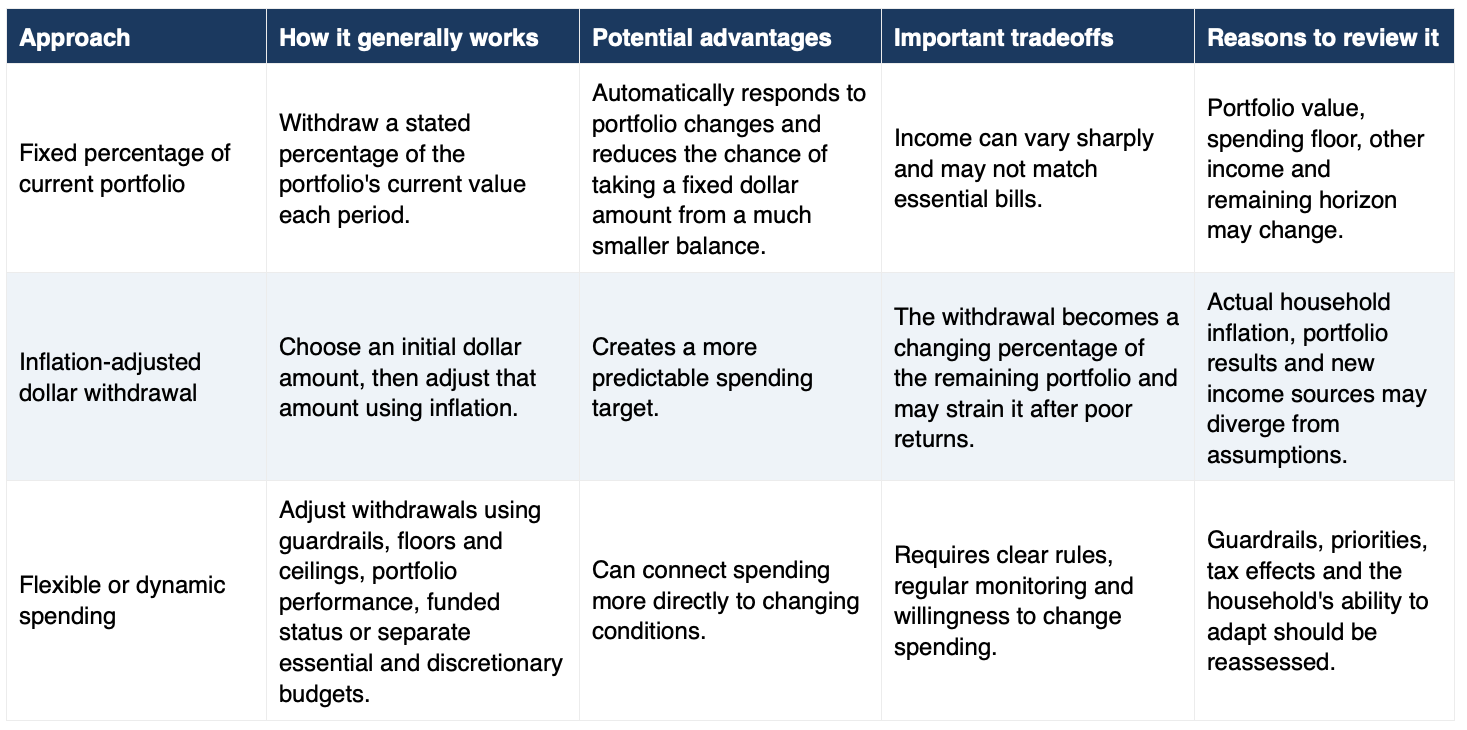
Other frameworks include life-expectancy-based, RMD-style and time-segmented methods. Research on retirement spending guardrails shows how decision rules can respond when rates cross preset ranges, but results depend on assumptions. See the Guyton-Klinger research.
A Hypothetical Nebraska Couple Reviews the Plan
Linda and Mark are a fictional Beatrice, Nebraska, couple, not actual clients. Both recently retired with a $1.1 million diversified portfolio and $40,000 of gross annual Social Security benefits. Their first gross portfolio withdrawal was $44,000, or 4%. Taxes would reduce the amount available to spend.
After one year, assume returns and withdrawals left $880,000. Their next inflation assumption was 3%, essential expenses rose $4,800 annually, Linda had a one-time $12,000 healthcare cost, and next year's travel budget fell $10,000.
All figures below are hypothetical, rounded and do not include investment fees, detailed tax calculations or future returns.
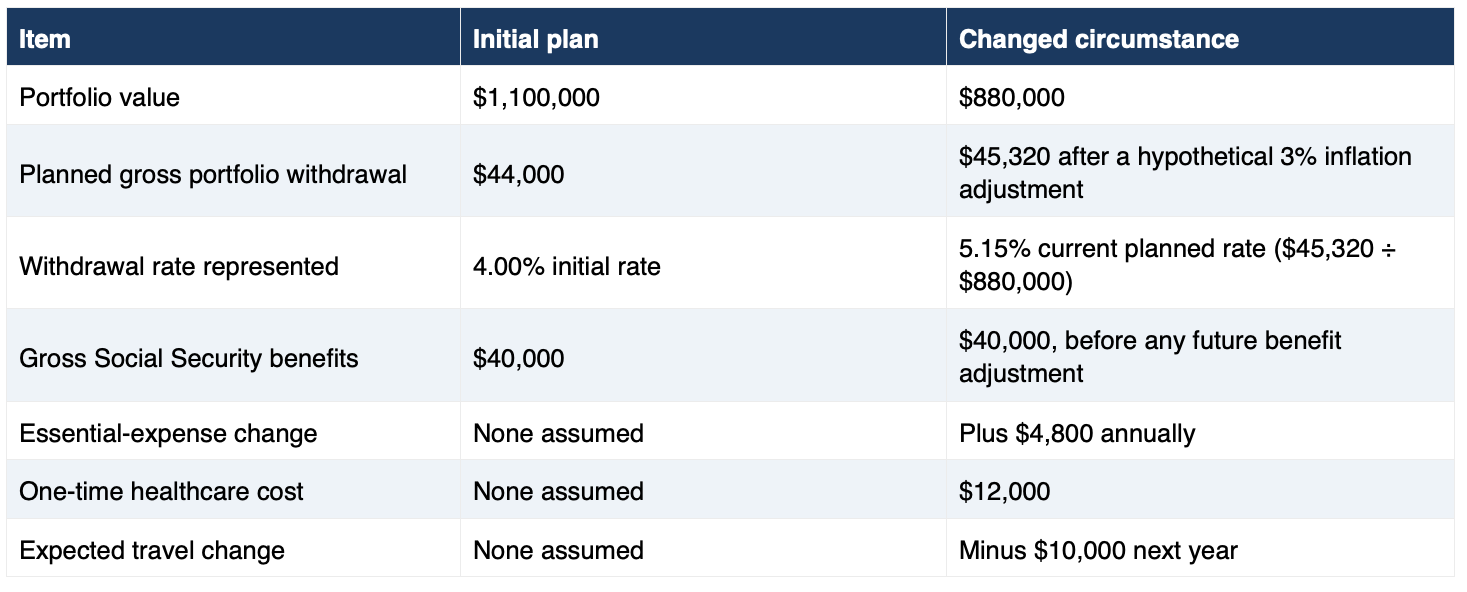
The table does not prescribe a response. Their review might test reducing optional spending temporarily, using an existing cash reserve, delaying a purchase, changing the withdrawal source, updating tax projections or revisiting gifts. Their process might restore discretionary spending if conditions improve. None of these choices is universally appropriate.
This is flexible retirement spending. They neither abandon the plan nor follow it blindly. They update the facts and decide deliberately.
Why the Source of a Withdrawal Matters
Two households can take the same gross withdrawal and keep different amounts.
- Traditional IRAs and employer plans: Pretax amounts are generally ordinary income when distributed. Basis and plan rules can alter the result.
- Roth accounts: Qualified distributions are generally federal-income-tax-free. Nonqualified distributions can follow different rules.
- Taxable investment accounts: A sale can create a capital gain or loss based on proceeds versus adjusted cost basis. Interest and dividends may be taxable.
- Cash reserves: Spending cash generally is not itself taxable, although the interest earned may be.
- Social Security: Benefits may be partly taxable depending on filing status and combined income.
- Pensions: Payments are generally fully or partly taxable depending on after-tax basis and plan terms.
- Qualified charitable distributions: A QCD generally requires a direct IRA trustee payment to an eligible charity and an IRA owner age 70½ or older. It can count toward an RMD. IRS guidance explains the requirements, and the 2026 exclusion limit is $111,000 per eligible individual.
Basis, holding period, other income and state law matter. Roth conversions, withdrawal sequencing, sales and QCDs warrant coordinated financial and tax analysis.
When Not to Overreact
Reviewing your retirement withdrawal rate after retirement is not an invitation to redesign your retirement income plan every time markets fall or the news feels unsettling.
Use an established process. Compare results with assumptions. Separate short-term volatility from lasting changes. Distinguish essential from discretionary expenses, and review several variables together. Many reviews may confirm that no change is needed.
Investments involve risk, including possible loss of principal. That makes disciplined reviews more valuable, but panic-driven investment or spending decisions can create new problems. A good review asks, “What changed enough to matter?” before asking, “What should we change?”
Ten Questions to Ask About Your Retirement Withdrawals Each Year
Save, print or share this checklist for your annual retirement income planning conversation:
- Has essential household spending changed?
- Has discretionary spending changed?
- Has inflation affected our household differently from national averages?
- Has the portfolio changed materially relative to the plan?
- Has our remaining planning horizon changed because of health, longevity or a spouse's needs?
- Have Social Security, pension income or required distributions begun?
- Could planned withdrawals affect income taxes or Medicare premiums?
- Are major healthcare, home or vehicle expenses approaching?
- Have family, charitable or estate goals changed?
- Could a surviving spouse comfortably understand and follow the current plan?
These questions are more useful than asking only, “How much can I withdraw in retirement?” The amount, source, timing and purpose of a withdrawal belong in the same conversation.
A Plan Built to Be Reviewed
An initial rate can provide structure, but your retirement withdrawal rate after retirement should not become an automatic lifelong instruction. A thoughtful retirement income plan is built to be reviewed, not ignored and not constantly reinvented.
For households considering retirement planning in Nebraska, a review can connect investments, taxes, healthcare, Social Security, pensions and family priorities. If you would value an educational conversation with a fiduciary financial adviser in Nebraska, Garnett Investment Strategies welcomes the opportunity. No withdrawal percentage is universally suitable or assured to last.
Garnett Investment Strategies is an independent Registered Investment Adviser and a financial adviser in Beatrice, Nebraska. A conversation can help you identify questions to coordinate with your financial, tax, legal and insurance professionals.
It All Starts with a Phone Call.
Primary Wealth Management dba Garnett Investment Strategies (“GIS”) is a registered investment adviser whose principal office is located in Nebraska. A copy of our current written disclosure statement discussing our advisory services and fees continues to remain available for your review upon request.