

Can You Retire on $100 a Day in Nebraska? A Realistic 2026 Retirement Budget
Could you enjoy retirement in Nebraska on $100 a day?
It is a useful question because $100 feels tangible. You can picture what it buys at the grocery store, the gas station or a local restaurant more easily than you can picture what a six- or seven-figure retirement account means for your everyday life.
That is ultimately what retirement income planning is about: translating Social Security, retirement accounts, pensions, savings and other resources into a sustainable way to pay for the life you want.
For some Nebraska retirees, $100 per day could support a modest lifestyle. For others, it would leave a significant gap. Housing, debt, healthcare, taxes, travel and family obligations can change the answer considerably.
What Does $100 a Day Mean for a Retirement Budget in Nebraska?
At exactly $100 per day:
- Annual spending: $36,500
- Average monthly spending: approximately $3,042
- Average weekly spending: approximately $702
The monthly figure is calculated by dividing $36,500 by 12, rather than simply multiplying $100 by 30.
There is another important distinction: $36,500 of gross retirement income is not necessarily $36,500 available to spend.
Taxes may apply to some retirement income. Medicare premiums can be deducted directly from Social Security benefits. Insurance premiums and other recurring costs may also come out before you think about groceries, utilities or recreation.
A useful retirement budget separates expenses into several groups:
Essential expenses include housing, food, utilities, healthcare and basic transportation.
Discretionary expenses include dining out, entertainment, hobbies and travel.
Irregular expenses include property taxes, insurance deductibles, vehicle repairs, home maintenance, appliance replacement and other costs that may occur only once or twice a year.
Those irregular expenses are easy to underestimate. A monthly budget can look comfortable until the furnace needs replacing or the car needs a major repair.
A Sample $100-a-Day Nebraska Retirement Budget
The following example illustrates what a $3,042 monthly budget could look like for one hypothetical retired Nebraska household.
Important: This is an educational illustration, not a recommendation, forecast or representation of an actual Garnett Investment Advisors client. It assumes a homeowner with no mortgage, relatively modest discretionary spending and no significant consumer debt. Actual expenses can be substantially higher or lower.
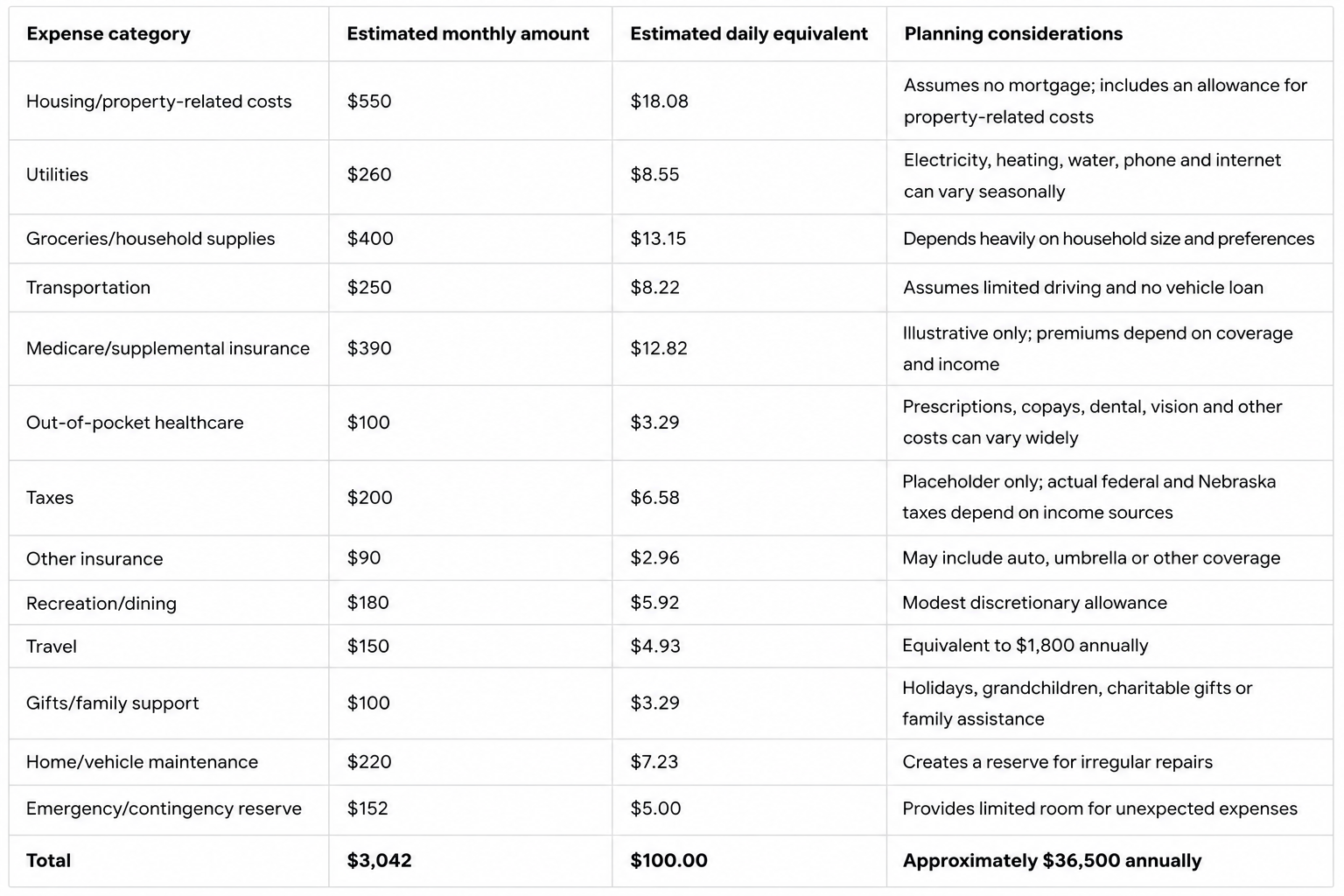
This example also shows why housing matters so much.
U.S. Census Bureau data for Nebraska covering 2020-2024 report median monthly owner costs of $1,736 for homeowners with a mortgage and $677 for homeowners without one. Median gross rent was $1,072. These are statewide medians-not estimates for a particular retiree-but they demonstrate how dramatically housing circumstances can affect a retirement budget. U.S. Census Bureau Nebraska QuickFacts
The sample's $550 housing allocation is therefore intentionally lean and would not fit many Nebraska households.
Healthcare deserves similar caution. The standard Medicare Part B premium is $202.90 per month in 2026, with a $283 annual Part B deductible. Higher-income beneficiaries can pay more because of Medicare's income-related monthly adjustment amount, commonly called IRMAA. CMS 2026 Medicare premiums and deductibles
The additional healthcare amounts in our sample are assumptions, not Nebraska averages or insurance quotes.
Where Nebraska May Help a Retirement Budget
Nebraska can offer some planning advantages, but they depend on where and how you live.
Housing can vary substantially by community
A home in Beatrice or another smaller Nebraska community may have a very different price and cost structure from housing in Lincoln, Omaha or another larger market.
The important question is not simply whether Nebraska is "affordable." It is what your specific housing costs will be in retirement-including property taxes, insurance, utilities and maintenance after the mortgage is gone.
Nebraska excludes Social Security benefits from state taxable income
Nebraska law currently allows taxpayers to reduce Nebraska adjusted gross income by Social Security benefits included in federal adjusted gross income. In practical terms, Social Security benefits are excluded from Nebraska individual income taxation under current law. Nebraska Department of Revenue Social Security tax information
Federal taxation of Social Security is a separate issue, so retirees should not assume that all Social Security retirement income is tax-free.
Some homeowners may qualify for property-tax relief
Nebraska's Homestead Exemption can provide property-tax relief to qualifying homeowners. For tax year 2026, eligible categories include certain homeowners age 65 or older, qualified disabled individuals, and qualified disabled veterans and surviving spouses. Some categories are subject to household-income and property-value limitations. Nebraska Department of Revenue 2026 Homestead Exemption information
Eligibility should be verified with the Nebraska Department of Revenue or the appropriate county assessor rather than assumed when building a retirement plan.
Where $100 a Day May Fall Short
A $100-a-day retirement budget has little room for certain expenses.
A mortgage or $1,000-plus monthly rent payment could consume a large portion of the budget before food, transportation or healthcare. Consumer debt creates similar pressure.
Travel can also change the picture quickly. A retiree who wants several substantial trips each year will need a different discretionary budget from someone who prefers local activities and occasional regional travel.
Healthcare is another variable. Medicare reduces many healthcare expenses, but it does not eliminate them. Premiums, deductibles, prescriptions, dental services, vision expenses and services not covered by Medicare can create additional costs.
Long-term care requires separate planning
Long-term care deserves particular attention because Medicare is not a general long-term-care funding program.
Medicare explains that it does not pay for most ongoing long-term or custodial care, such as extended help with bathing, dressing and other activities of daily living. Medicare Part A can cover qualifying short-term skilled nursing care under specific conditions, but that is different from indefinite custodial care. Medicare.gov long-term-care coverage explanation
Other circumstances that can put pressure on a $100-a-day budget include supporting children or grandchildren, caring for aging parents, maintaining multiple vehicles, major home repairs, higher property taxes, inflation or an earlier-than-planned retirement.
For couples, the death of one spouse can change both household income and taxes even though many household expenses remain.
That is why retirement planning needs to consider not only the expected years, but also the difficult ones.
Income Is Only Half of the Retirement Equation
Retirement expenses tell you what needs to be funded. The next question is where the money will come from.
Depending on the household, retirement income may include:
- Social Security
- Pension income
- IRA withdrawals
- 401(k), 403(b) or other employer-plan withdrawals
- Roth-account distributions
- Taxable investment accounts
- Cash reserves
- Annuity income, where applicable
- Part-time or consulting income
- Farm or business income
These sources are not necessarily taxed the same way.
Traditional retirement-account withdrawals, Roth distributions, Social Security benefits, taxable investments and business income can have different federal and state tax consequences. The timing and combination of withdrawals can also affect taxable income, Medicare income-related surcharges, how long investment assets last and estate-planning objectives.
This does not mean there is one "correct" withdrawal sequence. It means retirement income planning should consider taxes and spending together rather than treating every dollar of income as interchangeable.
For context, Social Security benefits received a 2.8% cost-of-living adjustment for 2026. Your actual benefit depends on your individual earnings and claiming history. Social Security Administration 2026 COLA information
Questions to Stress-Test Your Retirement Budget
Before deciding whether a $36,500 annual budget-or any other target-is realistic, ask:
- Does the budget include taxes and healthcare premiums?
- Is housing paid off, financed or rented?
- How much travel and discretionary spending do you expect?
- Is there a reserve for home, vehicle and medical emergencies?
- How would the plan respond to a significant market decline?
- What happens if inflation remains elevated for a period of time?
- Could either spouse require long-term care?
- Is the surviving spouse financially secure if one spouse dies first?
- Are gifts and other family-support obligations included?
- Has the plan been tested beyond average life expectancy?
A retirement budget checklist like this helps move the conversation away from a single number and toward the range of circumstances your plan may need to handle.
Three Ways a Nebraska Retirement Budget Might Look
1. Essential-needs retirement
This approach prioritizes housing, utilities, groceries, healthcare and transportation. Dining, travel, gifts and other discretionary expenses are kept relatively limited.
A $100-per-day target is more plausible under this approach when housing costs and debt are low.
2. Balanced retirement
A balanced budget leaves more room for restaurants, hobbies, family gifts, entertainment and occasional travel while still reserving money for repairs and unexpected expenses.
Depending on housing and healthcare costs, $36,500 may or may not provide enough margin.
3. Flexible or travel-oriented retirement
Some retirees want frequent travel, extensive hobbies, a second residence, substantial family gifting or more flexibility for experiences.
That lifestyle generally requires more discretionary spending and a larger margin for changing expenses.
None of these approaches is inherently better. The purpose of planning is to align financial resources with the life that matters to you.
So, Can You Retire on $100 a Day in Nebraska?
For certain households, yes: a $100-a-day retirement budget in Nebraska may support a modest lifestyle, particularly when housing costs are controlled, debt is limited and discretionary spending is moderate.
But $36,500 should not be treated as a universal retirement target.
A retiree with a paid-off home in southeast Nebraska has a very different starting point from someone paying rent, carrying debt, traveling frequently or facing substantial healthcare expenses. Couples also should not simply double a single-person budget because some household expenses are shared while others are not.
The more useful retirement-planning question is:
"What level of reliable, after-tax income will support the life I want while leaving room for unexpected costs?"
Answering that question requires connecting your expected Social Security benefits, retirement accounts, pensions and other income with your taxes, insurance, healthcare expenses, lifestyle goals and contingency reserves.
If you are approaching retirement and want to better understand how those pieces fit together, Garnett Investment Advisors can help you review your expected retirement income, expenses, taxes, insurance considerations and long-term goals. The purpose of that conversation is not to force your life into a predetermined retirement number, but to build a clearer planning framework around your circumstances.