

Could IRA Withdrawals Make More of Your Social Security Taxable?
A new vehicle, a major home repair, a family expense or a long-planned vacation can sometimes require more cash than your normal monthly retirement income provides.
If you take an extra withdrawal from a traditional IRA to cover the expense, the tax effect may extend beyond the IRA withdrawal itself. Because a taxable withdrawal generally increases your income, it may also cause a larger portion of your Social Security benefits to be included in federal taxable income.
That does not mean IRA withdrawals are inherently bad, nor does it mean retirees should automatically avoid them. The more useful question is how your IRA withdrawals and Social Security, pensions, investments and other income sources interact on the same tax return.
For many retirees, that coordination is an important part of retirement withdrawal tax planning.
How Social Security Benefits Become Taxable
The federal government does not impose a separate tax on Social Security simply because you withdraw money from an IRA. Instead, the IRS looks at a measure commonly called combined income or Social Security provisional income to determine how much of your benefits may be included in taxable income.
A useful simplified formula is:
Adjusted gross income + tax-exempt interest + 50% of Social Security benefits = combined income
For this purpose, adjusted gross income is generally considered before including taxable Social Security. The IRS calculation can also require certain excluded amounts—such as some foreign earned income or housing exclusions—to be added back.
The IRS explains the full calculation and provides worksheets in Publication 915, Social Security and Equivalent Railroad Retirement Benefits.
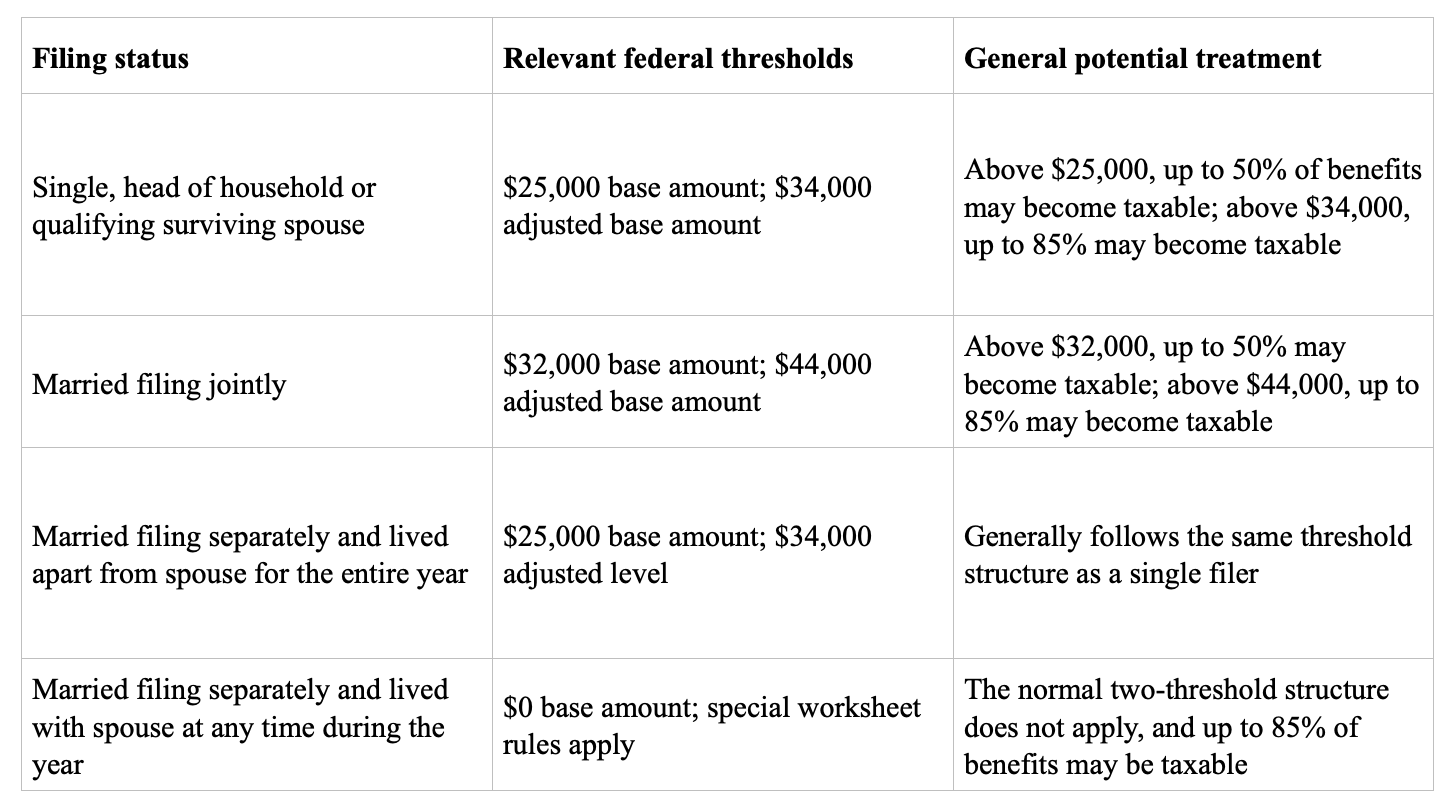
For most retirees, the basic federal thresholds are:
The IRS also summarizes these filing-status rules in its Social Security income frequently asked questions.
This table is only a simplified educational summary. An actual return should use the applicable IRS worksheet, tax software or a qualified tax professional.
What “85% taxable” really means
One of the most important distinctions in understanding how Social Security is taxed is the difference between the percentage of benefits included in income and the tax rate applied to that income.
“If 85% of my Social Security is taxable, I pay an 85% tax rate” is incorrect.
Suppose you receive $40,000 of Social Security and $34,000—85%—is included in taxable income. You do not owe $34,000 of tax. Instead, that $34,000 becomes part of the income used to calculate your federal tax liability. The actual tax depends on your deductions, filing status, tax bracket, other income and the rest of your return.
As explained in IRS Publication 915, the taxable portion generally cannot exceed 85% of your Social Security benefits.
Crossing one of the combined-income thresholds also does not normally create an immediate tax cliff. The taxable portion generally phases in under the IRS formula. During portions of that phase-in, however, an additional dollar of income can cause both that dollar and part of another dollar of Social Security to become taxable. That can temporarily create a higher effective marginal tax rate.
Why Traditional IRA Withdrawals Matter
Are IRA withdrawals taxable? For a traditional IRA funded with deductible contributions and earnings, distributions are generally taxable as ordinary income, although after-tax basis and other circumstances can change the result.
The same general issue can arise with taxable distributions from:
- Traditional IRAs
- Traditional 401(k) plans
- Traditional 403(b) plans
- SEP IRAs
- SIMPLE IRAs
- Other tax-deferred employer retirement plans
A taxable withdrawal can therefore have several potential effects at once. The distribution itself may be taxable, it may increase combined income, and that increase may cause more Social Security benefits to become taxable.
A higher modified adjusted gross income may also affect Medicare Part B and Part D income-related monthly adjustment amounts, or IRMAA, in a later year. The Social Security Administration generally uses federal tax-return information from two years earlier when determining whether an income-related adjustment applies. Readers can review the current process on the Social Security Administration’s Medicare premium page.
Depending on the household, additional income may also interact with tax brackets, deductions, credits and the taxation of investment gains. None of these consequences occurs in every situation, which is why retirement-income decisions are better evaluated together than in isolation.
Two Hypothetical Examples
The following examples are purely educational. They do not represent clients of Garnett Investment Strategies. Both assume no unusual exclusions, deductions or lump-sum Social Security elections that would require a specialized Publication 915 calculation.
Example 1: Single Nebraska retiree
Assume a single retiree receives $30,000 of annual Social Security. Before an additional IRA withdrawal, the retiree has $17,000 of other income included in the combined-income calculation and no tax-exempt interest.
The retiree then takes an additional $8,000 fully taxable traditional IRA withdrawal.
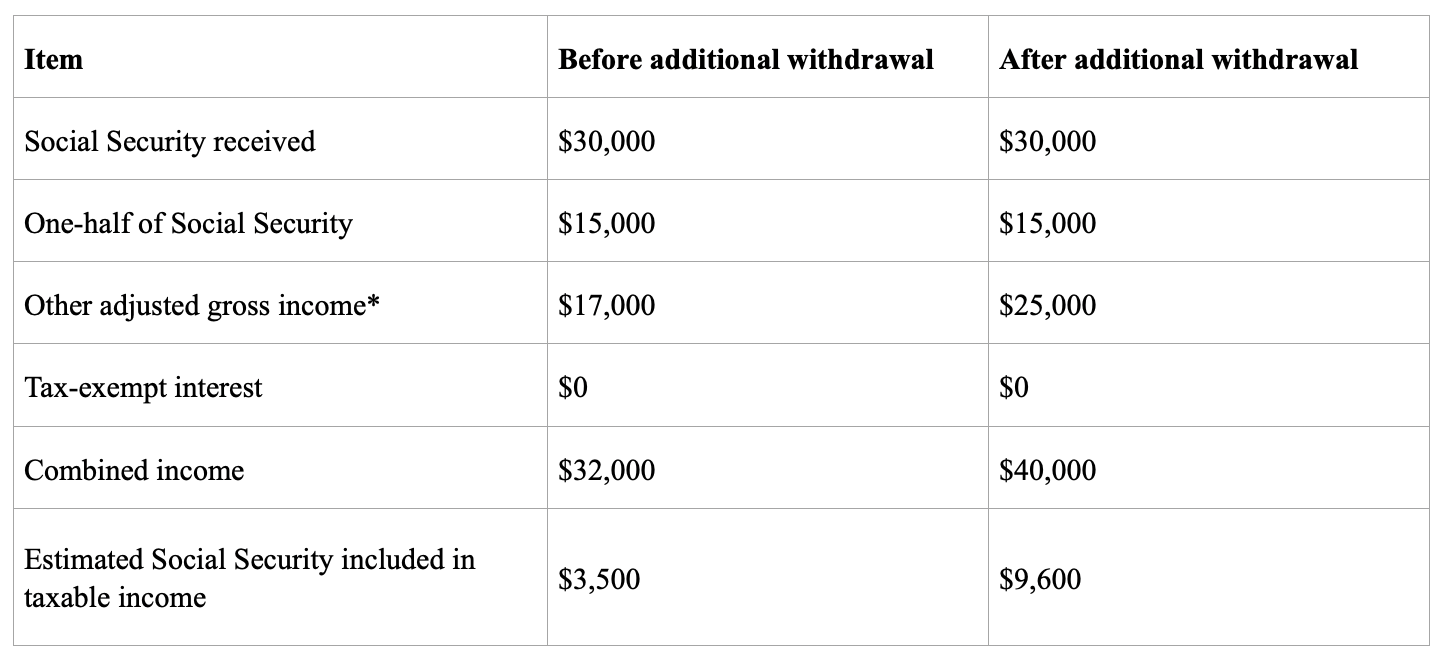
*For this simplified example, “other adjusted gross income” means income before taxable Social Security, with no special Publication 915 adjustments.
At $32,000 of combined income, the retiree is between the $25,000 and $34,000 levels. Under the standard IRS worksheet, approximately $3,500 of Social Security would be included in taxable income.
After the additional IRA withdrawal, combined income rises to $40,000. The estimated taxable portion of Social Security rises to approximately $9,600.
The $8,000 IRA withdrawal therefore does two different things in this example: it adds $8,000 of taxable IRA income and causes an additional $6,100 of Social Security to be included in taxable income.
That does not mean the withdrawal created $14,100 of tax. It means more income is potentially subject to the retiree's applicable federal tax rates. The final tax bill would also depend on deductions and the rest of the return.
Example 2: Married Nebraska couple filing jointly
Assume a married couple receives $48,000 of combined annual Social Security. They also receive a $12,000 taxable pension and take $3,000 from traditional retirement accounts, producing $15,000 of other income for the simplified calculation.
They later need another $10,000 and take an additional fully taxable IRA withdrawal.
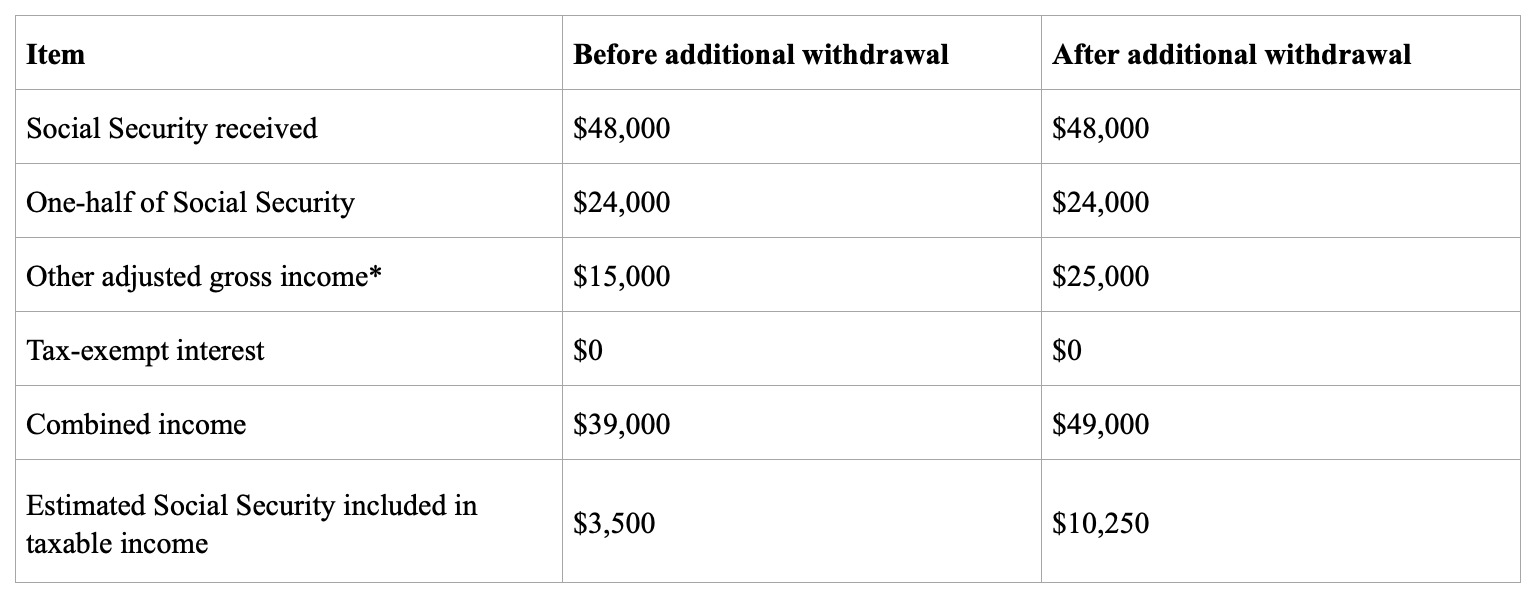
Before the extra withdrawal, combined income is $39,000—above the $32,000 joint base amount but below $44,000. Approximately $3,500 of benefits would be included in taxable income under the standard worksheet.
After the additional withdrawal, combined income reaches $49,000, and the estimated taxable portion rises to about $10,250.
The examples illustrate why filing status matters. The joint thresholds differ from those for a single taxpayer, and the exact result should be calculated using the worksheets in IRS Publication 915, appropriate tax software or a qualified tax professional.
Income Sources That May Affect the Calculation
Combined income can be influenced by more than traditional IRA distributions. Depending on the circumstances, relevant income may include required minimum distributions, pension payments, wages, self-employment earnings, taxable interest, dividends, realized capital gains, rental income and taxable annuity income.
Tax-exempt municipal-bond interest is particularly easy to overlook. Although that interest may be exempt from federal income tax itself, it is generally included when determining whether Social Security benefits are taxable under the calculation described in IRS Publication 915.
Capital gains can matter as well. A retiree may think of selling investments as simply generating spending cash, but realized gains generally enter the federal income calculation and may therefore affect combined income.
The tax treatment of annuity distributions depends on the type of contract, whether it is held inside a retirement account, the owner's investment in the contract and how payments are taken. Some payments may be partly taxable and partly a recovery of basis.
Income Sources That May Receive Different Treatment
Not every dollar available for retirement spending affects combined income in the same way.
A qualified Roth IRA distribution generally is not included in gross income. By contrast, a Roth conversion generally includes previously untaxed traditional IRA amounts in taxable income during the conversion year. A conversion can therefore increase combined income and potentially affect Social Security taxation or Medicare IRMAA in that year, even though qualified Roth withdrawals in future years may be tax-free.
Other distinctions include:
- Spending existing cash generally does not itself create taxable income, although interest earned on the cash may be taxable.
- A taxable investment-account withdrawal is not automatically taxable in full. Selling an appreciated investment can create a taxable capital gain, while the portion representing cost basis is generally a return of capital.
- Traditional IRA distributions may be partly nontaxable when the owner has after-tax basis, but special pro-rata rules apply.
- HSA distributions used for qualified medical expenses generally are not included in income.
- A qualified charitable distribution, or QCD, made directly from an eligible IRA to an eligible charity may be excluded from income when all applicable requirements are satisfied and may count toward an RMD.
The IRS explains IRA distribution rules, including required minimum distributions and qualified charitable distributions, in Publication 590-B, Distributions from Individual Retirement Arrangements.
These differences do not mean one source should automatically be used before another. Account selection should be considered in the context of spending needs, taxes, investment strategy, estate planning and other objectives.
The Potential Planning Window Before RMDs
Some households experience a period between retirement and the start of required minimum distributions when taxable income is temporarily lower.
There may also be separate dates for beginning Social Security and enrolling in Medicare. Those overlapping timelines can create useful planning opportunities, but they do not automatically make those years the “best” time for Roth conversions, capital-gain realization or another tax strategy.
Current RMD ages depend on a taxpayer's birth year under federal law. IRS Publication 590-B provides the current rules for when IRA owners generally must begin required minimum distributions.
Evaluating this period may involve:
- Current and expected future tax brackets
- Social Security claiming decisions
- Projected required minimum distributions
- Medicare IRMAA
- Available cash for taxes
- Charitable intentions
- Estate and beneficiary goals
- State income-tax treatment
- Investment considerations
- The possible future position of a surviving spouse
No single approach fits every household.
The Surviving-Spouse Tax Issue
Retirement-income planning for married couples should also consider what may change after the first spouse dies.
A surviving spouse may eventually file as a single taxpayer. One Social Security benefit generally ends, yet the survivor may continue to own much of the household's tax-deferred retirement savings.
At the same time, the federal Social Security thresholds for a single filer are lower than the joint thresholds. Medicare income thresholds and ordinary income-tax brackets can also differ for a single taxpayer.
This is not a reason for alarm. It is simply another reason to evaluate retirement decisions over a longer horizon instead of focusing only on the current year's tax return.
Does Nebraska Tax Social Security?
Federal and Nebraska tax treatment should be separated carefully.
For federal purposes, Social Security benefits can still be included in taxable income under the combined-income rules discussed above.
For Nebraska purposes, current law provides a subtraction for Social Security benefits that are included in federal adjusted gross income. The Nebraska Department of Revenue explains the change in its summary of Nebraska legislative tax changes.
So, to answer the common question “Does Nebraska tax Social Security?”, federally taxable Social Security is currently removed through the applicable Nebraska adjustment.
That state treatment does not make the Social Security federally tax-free.
Traditional IRA and retirement-plan withdrawals are a separate issue. Nebraska's individual income-tax calculation generally begins with federal adjusted gross income, which means federally taxable retirement distributions may remain part of the Nebraska calculation unless a specific state adjustment or exclusion applies.
Because state tax laws can change, Nebraska retirement tax planning should always use the rules applicable to the specific tax year involved and, when appropriate, current guidance from the Nebraska Department of Revenue.
Questions to Ask Before Taking a Large IRA Withdrawal
Before making an unusually large retirement-account withdrawal, useful questions for discussion may include:
- How much of the withdrawal will be federally taxable?
- Could the withdrawal cause more of my Social Security to be included in taxable income?
- Could the income affect my Medicare premiums in a later year?
- Could it affect the taxation of long-term capital gains?
- Would taking an expense in more than one tax year produce a different overall result?
- What cash, taxable, traditional retirement and Roth resources are available?
- Should federal or state withholding or estimated-tax payments be reviewed?
- Could any portion of the distribution be subject to an additional tax on early distributions?
- How could the decision affect the financial position of a surviving spouse?
- Should the decision be coordinated among my financial adviser and qualified tax professional?
These are questions for evaluation, not a recommendation to use any particular account.
Coordinate the Income Sources, Not Just the Tax Bill
Traditional IRA withdrawals can affect more than your IRA balance. Because taxable withdrawals generally increase income, they can also cause a larger portion of Social Security benefits to be included in federal taxable income.
The objective of retirement planning, however, is not simply to produce the smallest possible tax bill in one calendar year. A thoughtful plan may need to balance lifetime taxes with reliable income, spending needs, portfolio sustainability, Medicare costs, charitable goals, estate considerations and the financial security of both spouses.
For retirees and families in Beatrice, Lincoln and communities throughout southeast Nebraska, Garnett Investment Strategies can help organize those moving pieces through an educational, fiduciary-focused planning process. A conversation can look at how Social Security, retirement accounts, pensions, investments and expected expenses fit together—and where coordination with your tax or legal professional may be appropriate.
Why Wait – It All Start’s with a Phone Call
Primary Wealth Management dba Garnett Investment Strategies (“GIS”) is a registered investment adviser whose principal office is located in Nebraska. A copy of our current written disclosure statement discussing our advisory services and fees continues to remain available for your review upon request.